

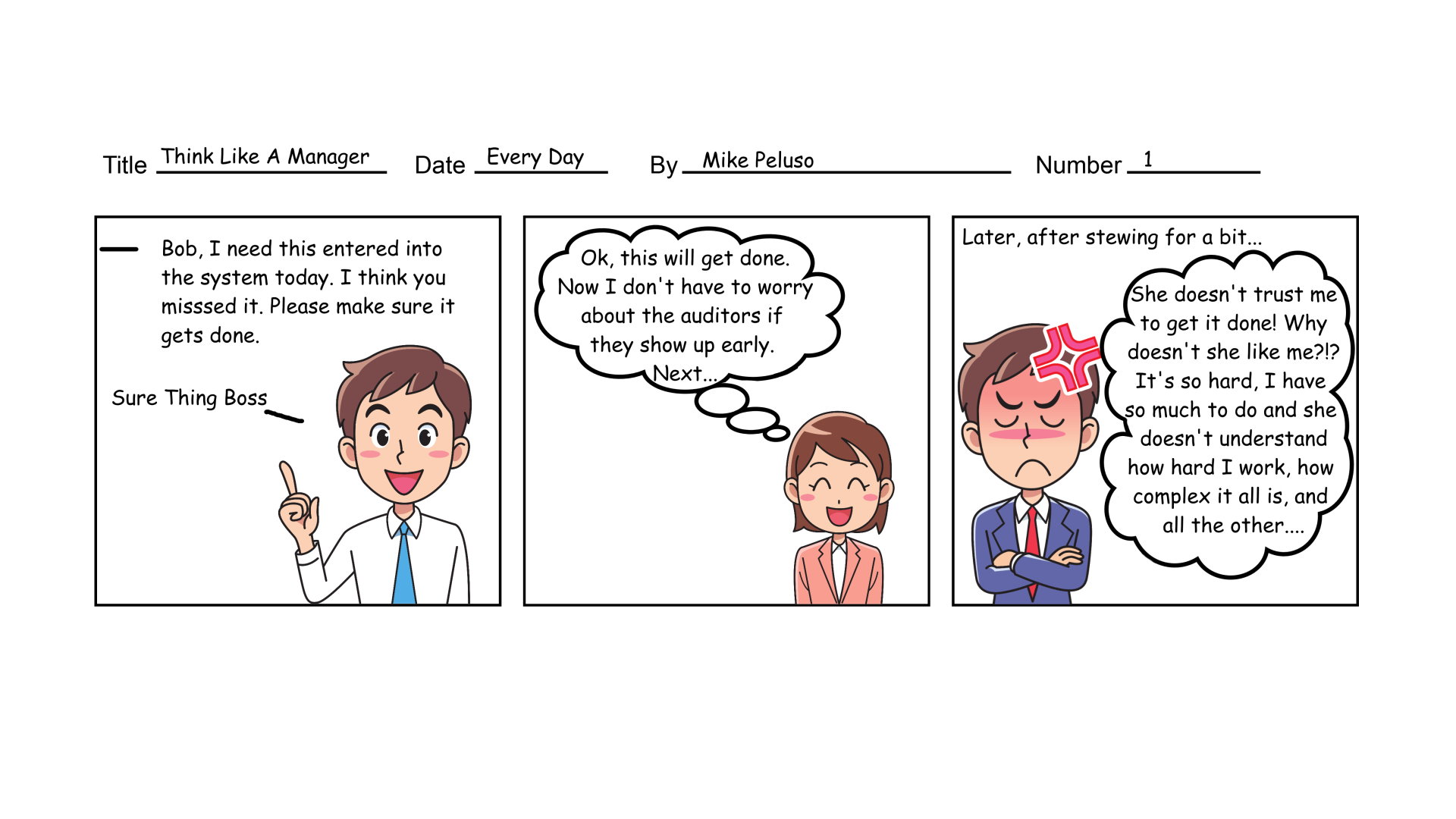
I was talking with Blanca, a younger friend of mine who works in logistics for a large EF&I company. EF&I, for the unfamiliar, is a term meaning Engineer, Furnish and Install. It’s a very common type of company. There are EF&I’s in nearly every industry. In a municipal construction roadway improvement project an EF&I company would design a bridge, sell you the massive girders needed for the bridge, and have work crews they could deploy who knew how to tear out the old bridge and build the new one. EF&I companies in Information Technology would design the data center, sell you the servers, and get them all hooked up. Corporations like doing business with EF&I’s as they simplify large projects by offering one stop shop services. Blanca’s job was as an administrator in project coordination. The work she did touched many of the different departments of the company, its vendors, and its customers. She’d only be on the job for about a year, prior to that she worked at the Dollar store in town. Blanca was upset, she had gotten written up. It’s why she was calling me, to vent. She said it was because her boss didn’t like her. I knew her boss as well, and I knew this wasn’t the case. I couldn’t tell Blanca that outright. It would betray a trust and put me in an awkward position. I just tried to console her as best as I could. I felt for her, I understood why Blanca got written up, but she didn’t. She was at a loss simply because she couldn’t think like her manager.
First the disclaimer, When I say she couldn’t think like a manager, I meant she couldn’t think like a good manager, a professional manager. Also, a good manager is a bit of a moving target. It’s not super easy to quantify. There are managers, many of them, who are just bad. Really bad. Managers are people too and they have personality quirks. They sometimes get promoted into their position, not because they are good, but because there is nobody else available. So naturally the less professional managers can make the same mistakes as any human. I’m talking today about good managers, strategic managers, those who understand the organization, the priorities within it, and how those priorities define their job and the jobs of their subordinates.
I think Blanca called me because she knew I’ve been written up before, numerous times, over the course of my career. Why? Well, one reason was that nobody explained to me how the managers were thinking, at least not in a way that I could understand. Also, I wouldn’t consider my younger self a professional yet. I was a worker and I was in a professional job, but I wasn’t prioritizing my job like a professional, let alone a manager. One of the unique elements of being a seasoned professional is their ability to think outside your own job. It’s a strategic type of thinking. Often at the beginning of our career we think in terms of our own experience, the human experience. We think emotionally and make decisions as such. That’s how I was thinking in my earlier years. It’s exactly like Blanca was thinking.
In all honesty, I only started thinking like a manager when I went to several Human Resource affiliated meetings and interfaced with HR professionals. Slowly, over time, I learned that good management is all about organizational and people prioritization. For the record, this experience is why I think everyone should work in HR. Managers, no matter the position, or I should say a huge component of management, is almost indistinguishable from Human Resources. A good manager sees people as people, but also as an organizational resource, i.e they see and can work with both the human side and the resource side.
So what are the differences in how a manager thinks and someone who doesn’t think like a manager? It’s almost like you need a sunday comic with characters’ thought bubbles to try and actually explain how hard it is for some people to get in the mindset of a manager. An emotional employee may think something like: “She doesn’t like me and that’s why they wrote me up/ demoted me / didn’t give me the big project. I’ve done no wrong, in fact I have a huge workload and I got 99% of my work done perfectly. I’m doing a great job! Why doesn’t she see that?!?” This is sensemaking on the part of the employee. In that scenario, the manager is thinking: “Crap, this girl can’t get the work orders straight and now the other departments are starting to come down hard on this. In her job you need to be perfect all the time because that’s what’s required or there is a domino effect across the whole organization and we’ll lose dozens if not hundreds of hours of productivity if this keeps. About every four months some kind of error comes from her. If I don’t formally write her up, then it’s going to look like I’m not addressing this problem and the VP will come down hard on our whole department!”
Unfortunately the employee who doesn’t think like a manager also doesn’t react to the situation properly. The hurt employee, thinking like a human with human needs, reacts by bitching to friends and colleagues because that’s a natural response when we feel we have been wronged. Of course, this type of venting gets out like a child’s game of telephone, usually in a way where the story is skewed, and that leads to even greater schism as the manager learns of the highly unprofessional venting. The manager knows you should resist bringing emotions into the job as it affects the emotional response of others. At this point things devolve to where the manager puts in protocols to limit gossip. Since she doesn’t trust the employee she’ll do things such as never having a meeting with her without someone else in the room . The whole thing becomes an ever escalating cycle until someone is let go.
So how can we break this cycle? How can we get people to react more like a manager? An option, one that doesn’t work all that well, is to just put people in intense ‘training’. There is an abundance of formal management training programs available. In my experience the information in them never really sticks. It’s well known that people only retain about 5%-10% of what they are shown in class. It’s a bit like going to school to get a degree. You get the introduction to a type of job, but you don’t really understand it until you start doing the job day in and day out for years. That’s one of the reasons why, as I cited earlier, I think everyone should work in HR. It’s definitely training by immersion in a culture of management thinking.
One of the biggest challenges to people who don’t think like management is the rate at which humans change. Blanca may one day overcome her lack of professionalism, but it will take micromanagement and years of socialization. Unfortunately, most organizations don’t have time or the resources to invest into someone like Blanca. Blanca’s organization needs someone who’s more professional tomorrow, which is why she’s been put on notice. The organization is saying, in the most formal way possible: become that person, or you won’t be sticking around.
If we remove ourselves from Blanca’s plight, The concept of going from thinking like a normal person with thought processes rooted in our cultural socialization to being a manager is an interesting switch to flip. Unfortunately, one way to do it is to stop thinking about people as people, and start thinking about them as products, tools or, in the modern vernacular, resources.
I teach a professional development class. Often I find myself ranting to my students about this very thing. I’ll tell them: you are the product!! Then I’ll give them an analogy about a person at the food production table working at a biscuitville. I live in the south and Biscuitville resonates with some students much more than using a more popular choice like McDonalds would. I ask them how they are feeling when they are in a long line that’s moving slowly and they see the person at the make table ignoring the customers because they are on the phone or talking to another employee. Even if that person has a pressing emotional issue, are they happy to sit while the biscuit maker vents about his or her emotional issue first or do they want the person to save that for after work and to focus on the biscuits? I ask them what they think the owner of the Biscuitville wants, a human employee with human issues, or a human employee who’s got a good work ethic and is reliable, dependable and puts the customers above themselves? Clearly the students, many of whom have had the experience I described a few times in their lives, believe the unproductive employee should be professional and put the emotions on the back burner until the shift is over. I then go to say that they, i.e. my students, need to think about their job from the company’s perspective. What does the company and the store manager want? That’s what they should offer. The Store has a problem, it needs to serve people quickly and without issues. When they interview, they need to think like the manager and explain how they are the product that can fix the problem i.e. they are quick and dependable, and customer focused.
There are clear benefits to thinking like a manager for the individual and the organization. The biggest of them is that it becomes very easy to understand what a manager needs out of you, and that gives you a clear understanding of what it takes to not just stay out of trouble, but to be more successful overall. As an example in Blanca’s case she would know that 99% wasn’t good enough and she’d make sure to double and triple check her work so that it was 100% correct. Thinking like a manager may even get you to the next level. We act based upon our thoughts and feelings. If you can compartmentalize your feelings and you think like management, then the natural outcome is to start to act like management. Then if you want to be a manager, it’s easy to move into a manager’s role. I’ve had that experience in that I’ve been asked to be a manager simply because it was assumed that I had the experience from the way I acted.
To realize these benefits, it would be better if more people thought like managers sooner in their career. That leads back to the question: How do you get people to start to think like a manager? I think the first thing should go without saying, but often it gets forgotten. The employee in question needs initiative. They need to have a desire to know how managers think. In addition, and possibly more importantly, they also need to be aware of how their emotions affect their thinking. On top of that awareness, there needs to be the development of some measure of control over those emotions. This can be incredibly hard for people. Blanca is one of those people who has never mastered her emotions.
I believe that learning to think like a manager, for those who are open to it, happens organically over time. This is the hard way for sure, as it can involve things like making mistakes that lead to disciplinary actions. It’s a bit like growing up. We do have to make mistakes and we learn from those mistakes. We also learn from watching others and listening to managers. Over time we start to figure it out. Unfortunately, this process takes forever. In an ideal world, the move to thinking like a manager would be highly expedited if there was complete transparency when managers make the decisions they do. Everyone would understand exactly why managers make their decisions including the thought processes they go through and the priorities they have. Unfortunately there is a huge negative with this approach in the form of competitive pressures and legal liabilities. For better or worse the world is a very litigious place and for these reasons organizations will never be truly transparent.
One option is micro mentoring. Think of it like micromanaging, but the focus isn’t about work efforts, it’s about changing the way someone thinks. In a micro mentoring scenero I could see continual job shadowing as a component. This is another solution with a big negative in that there is a huge investment in time on part of a mentor. For it to work the mentee needs to be emotionally mature, and that never happens overnight. It takes years.
I mentioned earlier that a job in employee relations or HR is an option. These groups are always almost the most practical people in every organization. I have never met an HR professional who was overly emotional about the job. I think they understand performance and management better than most managers because they are forced to deal with these topics every day. Working in these positions is a lot like being exposed to formal leadership and management training again and again.
Thinking like a manager, a good manager, is very hard to do if you have never been in that position. Yet there is value in changing your thought process to be more in alignment with management as it can have some very big positives. Conversely, not thinking like one can have big negatives. Ideally, we’d all have some sort of regular ongoing training to help us think more like the management we work for. That’s not the world we live in. Forcing yourself to think like management is one of those things that, for the most part, has to be undertaken because of an internal motivation. My friend Blanca needs to coerce herself out of the crutch of “She just doesn’t like me” and get to something more like “I wonder what factors in my behavior led to this, and if it’s not easy to change, then how can I mitigate them moving forward?” When put like that, it’s easy to see how the human element can stifle the move to dispassionate managerial thinking. Emotions are very hard to get around for emotionally driven people.
I’m going to keep consoling Blanca, and maybe, possibly, and somewhat deftly, throw in a bit of advice every now and again about ways she can better understand what managers are thinking. She won’t change overnight, but the way I see it, if I was able to start thinking like a manager, then anyone can do it. Even Blanca.


